

STRATEGIC REAL ESTATE MARKET INTELLIGENCE REPORT
Optimizing First-Time Homebuyer Placement & Portfolio Entry Strategies Using Outlier-Resistant Statistical Frameworks
| Prepared By: | Aurora and Joshua Lindo | Date: | June 26, 2026 |
| Target Group: | First-Time Home Buyers & Asset Planners | Dataset Filter: | Middle 90% Range ($124.9k – $967k) |
Executive Summary & Core Objectives
The entry-level residential real estate landscape across the United States, and specifically within the state of Florida, has shifted dramatically over the past two decades. Structural undersupply, prolonged periods of historically low interest rates followed by rapid tightening cycles, and immense net domestic migration have combined to fundamentally reshape pricing dynamics. Over the last fifteen years, median property valuations across primary Florida metropolitan areas have accelerated by approximately 300%. This massive appreciation curve has created an unprecedented capital barrier, leaving many unguided first-time homebuyers facing a market that appears mathematically insurmountable.
The core objective of this strategic intelligence report is to dissect raw market data to find highly predictable, high-value avenues for entry-level buyers. By evaluating a granular dataset comprising 9,785 unique property records throughout Florida, this analysis isolates municipal pricing trends, physical dimensions (square footage), and localized discount indices. The resulting framework provides a reliable guide to identifying specific geographic sub-markets that offer the optimal blend of absolute affordability, structural utility, and favorable contract negotiation space.
Research Methodology & Outlier Mitigation
In high-stakes real estate market analytics, a foundational rule is to prevent extreme, unrepresentative transactions from skewing localized or statewide averages. In a state like Florida, home to multi-million-dollar ultra-luxury compounds along the coastal strips (e.g., Palm Beach, Miami Beach, and Naples), a simple unweighted arithmetic mean would introduce a massive upward bias. Such a bias would render generalized conclusions useless for a household looking for an entry-level home. Conversely, distressed nominal quit-claim transfers or unbuildable utility parcels can introduce an artificial downward bias.
To address this and establish a rigorous, repeatable baseline, a strict statistical truncation protocol was implemented. This study excludes the top 5% and bottom 5% of all recorded transactions, focusing exclusively on the middle 90% of the active transaction field. This trims the dataset to 9,785 core properties. The calculated lower boundary stands at $53,000, while the upper boundary stabilizes at $1,490,000. By analyzing this specific price band, we ensure that every observation reflects a highly realistic option for professional households applying conventional or FHA loan parameters.
Statewide Market Findings & Macroeconomic Trends
| Statistical Metric | Value Within Middle 90% Universe |
| Average Overall Listed Price | $446,505.97 |
| Average Overall Realized Sold Price | $429,610.06 |
| Average Contract Negotiation Spread | 4.13% (Average $16,894.95 Concession) |
| Average Unit Valuation ($/sqft) | $257.87 per Square Foot |
The Economic Impact of Contract Concessions
A critical revelation for first-time buyers is that listed figures do not represent fixed transactional endpoints. The statewide average contractual spread shows a 4.13% contraction from the initial list price to the final closing contract. This means a buyer saves an average of $16,894. For a household earning a median hourly wage of $20.00 per hour, this single data point represents 850 hours of pre-tax labor. Capitalized over a standard 30-year amortization schedule, this negotiation spread translates to tens of thousands of dollars in preserved capital, which can be redirected toward immediate property equity or necessary modern capital improvements.
City Affordability Analysis
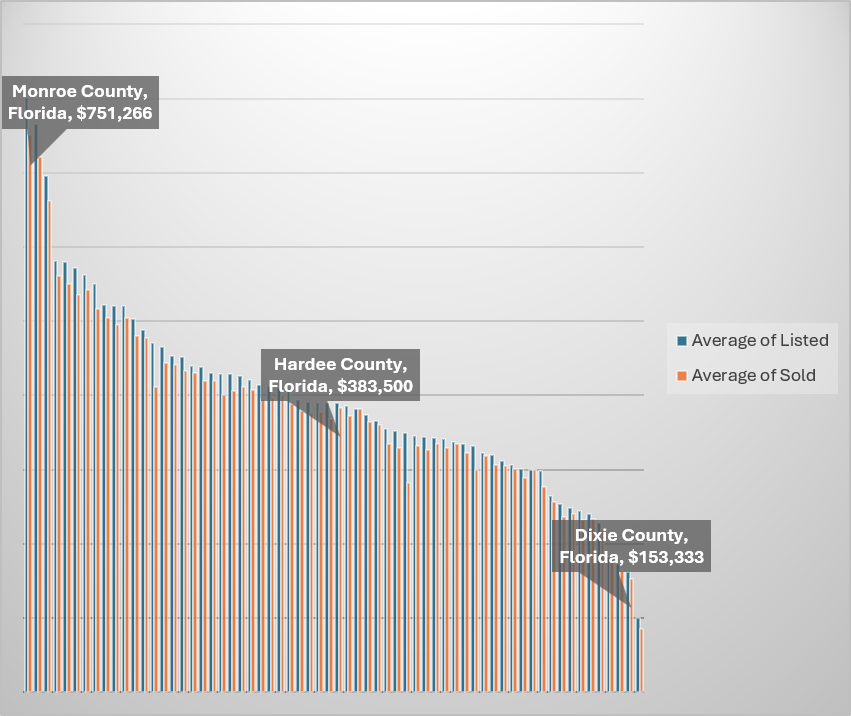
Geographic dispersion is the defining characteristic of Florida’s real estate market. Buyers who restrict their search to broad regional terms often overlook significant pricing inefficiencies available at the municipal and zip code levels. Below, we examine the opposing ends of our trimmed dataset to isolate where buyer leverage is strongest.
Top 5 Most Affordable City Corridors (Minimum 10 Transactions)
The following sub-markets represent the most financially accessible regions within the middle 90% framework. These areas are characterized by solid entry points well below the statewide average.
| City / Municipality | Avg Listed Price | Avg Sold Price | Avg Contract Spread | Avg Price / Sqft |
| Chipley | $215,140 | $209,794 | 2.33% | $142.21 |
| Holiday | $243,012 | $238,187 | 2.56% | $191.56 |
| Defuniak Springs | $249,848 | $241,698 | 3.60% | $173.45 |
| Port Richey | $259,494 | $249,300 | 4.92% | $203.95 |
| Inverness | $270,138 | $261,704 | 3.32% | $188.49 |
Strategic Recommendations for First-Time Buyers
The raw data supports moving away from generic, statewide searches and adopting a focused strategy targeting highly specific regional centers. First-time buyers must carefully weigh absolute entry costs against long-term physical utility.
The Balanced Hub Strategy: Optimizing Space and Budget
While areas like Chipley and Holiday present the lowest barriers to entry, they may not meet the lifestyle or career requirements of all working professionals. For buyers seeking the optimal balance of affordability, structural layout, and regional economic activity, Winter Haven and Leesburg stand out as premier options.
• Leesburg Market Dynamics: This municipality offers a stable average sold price of $274,531, combined with a spacious average layout of nearly 1,700 square feet. This produces a highly competitive unit valuation of $166.83 per square foot, making it an excellent choice for expanding family units requiring immediate square footage.
• Winter Haven Market Dynamics: Backed by a strong sample size of 53 distinct transactions within our core dataset, Winter Haven represents a highly resilient market center. Properties here feature an average sold price of $285,884 and an expansive average size of 1,803 square feet. This delivers maximum spatial efficiency at just $164.29 per square foot within a vibrant, growing community.
| Strategic Down Payment Action Plan: Assuming a benchmark purchase price of $285,000 within the Winter Haven market, an entry-level 5% down payment program requires $14,250 in liquid capital. By establishing a structured, automated monthly savings target of exactly $600, an entry-level buyer can accumulate the necessary down payment within 24 months. This systematic path bypasses the lengthy timelines required to build a traditional, restrictive 20% down payment, allowing buyers to start building equity much sooner. |
Leveraging Inefficiencies in Negotiation Hotspots
Buyers looking to maximize their initial equity should focus on high-discount municipal pockets like Port Richey and Defuniak Springs, where average contractual savings range from 3.60% to 4.92%. When submitting proposals in these high-leverage zones, buyers should structurally anchor opening bids 5% to 7% below initial asking configurations. This tactical approach uses local historical closing patterns as empirical justification during the contract phase, significantly improving the chances of securing a favorable deal.
Long-Term Financial Planning & Risk Mitigation
Purchasing a primary residence involves more than simply matching the initial purchase price; it requires a comprehensive understanding of long-term carrying costs. First-time buyers must evaluate ongoing financial obligations to ensure true structural housing stability:
• Insurance Cost Mitigation: Homeowners insurance premiums in Florida are heavily influenced by geographic proximity to coastal storm bands. Internal regions, such as Winter Haven and Leesburg, generally benefit from lower risk classifications, leading to substantial annual premium savings compared to exposed coastal alternatives.
• Assessment Exemptions: Property taxes are tied directly to localized millage rates and assessed values. Utilizing state exemptions (such as the Homestead Exemption) can significantly reduce taxable valuation baselines, protecting new owners from unexpected budget strain.
• HOA Fee Avoidance: Selecting properties that do not carry restrictive Homeowners Association (HOA) or Condominium fees provides buyers with complete control over their monthly outlays, speeding up capital growth and wealth accumulation.
Detailed Multi-Variate Analytical Conclusion
The contemporary Florida real estate ecosystem is far from uniform. While mainstream news outlets often focus on extreme, double-digit price increases and ultra-luxury coastal sales, an outlier-resistant evaluation of the middle 90% core reveals an accessible, highly practical marketplace for buyers who use data-driven strategies.
For buyers focused on absolute budget preservation, the northern and central-coastal pockets—led by Chipley ($209,794 average sold price) and Holiday ($238,187 average sold price)—provide highly viable, low-risk options for transitioning from renting to homeownership.
For buyers seeking the optimal balance of long-term utility, square footage, and community infrastructure, central hubs like Winter Haven and Leesburg deliver the highest return on investment. These areas provide spacious, family-sized homes averaging 1,700 to 1,800 square feet at unit costs well below $170 per square foot, keeping them highly attainable through structured 24-month savings programs.
Ultimately, navigating today’s real estate market successfully requires thorough preparation, careful geographic targeting, and the confident use of historical contract negotiation margins to establish long-term financial security.
Leave a Reply